
Fabric Weight And Drape
June 3, 2026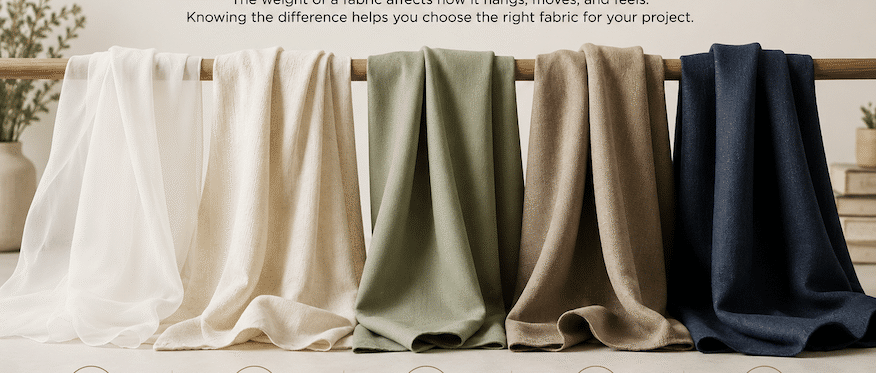
0 items in your cart
Your cart is currently empty.
Start shopping Fast Delivery
Excellet Quailty
Unique designs
Fast Delivery
Excellet Quailty
Unique designs
Learning these two essential qualities helps you choose the right cloth — even when you can’t touch it first.
When you shop for fabric online, can you picture how it will look on your body, or feel when you sew with it? For many sewists, it’s difficult to imagine what will arrive at the doorstep. Two pieces of knowledge help bridge that gap — and understanding both changes how you shop forever.
There are two ways to truly know a fabric. The first is technical: researching the qualities of individual fibres — cotton, rayon, silk, polyester, wool — and understanding how those fibres are knit or woven together. This tells you about dye absorption, moisture-wicking, warmth, and stretch.
But the second way is sensory. You see how the fabric drapes on your body, how hefty it feels when you pick it up, and how it moves when you walk. When shopping online, you miss almost the entire sensory experience.
A quick vocabulary lesson can bring fabric descriptions to life — even when you cannot touch a single thread.
Getting familiar with the sensory qualities of fabric — specifically weight and drape — helps you predict how it will behave when you unbox it, sew it, and wear it. The more you practise reading descriptions with these terms in mind, the more quickly you’ll learn to speak textiles.
The weight of a fabric is simply how much it weighs — how light or heavy it is when you hold it. While fabrics are often described casually as lightweight, medium weight, or heavyweight, each fabric also has a specific, numerical weight.
You’ll typically encounter two measurements: ounces per square yard (OYS), used imperially, and grams per square metre (GSM), used metrically. Understanding what these numbers mean in practice is the key to better fabric choices.
| CATEGORY | OYS | GSM | |
|---|---|---|---|
| Lightweight | Up to 7 oz | Up to 237 | |
| Medium weight | 7–11 oz | 237–475 | |
| Heavyweight | 11 oz+ | 475+ |
Lightweight – Thinner, more breathable, drapier, often less opaque
Medium weight – Balanced structure and flow, versatile for most projects
Heavyweight – Thicker, more durable, more opaque, more structured
Denim is a perfect example for exploring weight. Online shops often list it in detail, and ready-to-wear jeans often note the specific weight on the label. You’ll find denim ranging from just 5 ounces all the way to 32 ounces — and the difference in wearing experience is enormous.
A heavyweight denim at 438 GSM (12.9 oz) is stiff, durable, and structured, holding its shape even when hanging — ideal for aprons, overalls, and hard-wearing jeans. A medium-weight denim at 329 GSM (7 oz) has a foldable drape and works well for jackets and skirts. A lightweight denim at just 203 GSM (6 oz) is soft, thin, and breathable — it hangs in relaxed folds, suited to loose trousers and casual shirts.
Should the fabric be sheer or opaque?
Will a lighter fabric be difficult to sew for this project?
Will heaviness create bulky seams?
Will the fabric tolerate stress at stress points?
How do I want the fabric to feel on my body — consider breathability and ease of movement.
It’s worth remembering that GSM reflects weight alone. It tells you nothing about weave density, additional fibre content, drape, or stretch. Always read it alongside the shop’s written description.
Drape describes how a fabric hangs on your body — how it falls and folds. It’s often confused with weight, which makes sense because the two are highly correlated: heavy fabrics often have less drape, and light fabrics often have more.
However, this relationship is not always proportional. There are heavier fabrics that flow beautifully — a heavy wool crêpe, for instance — and light fabrics that are surprisingly stiff, such as organza. Fabrics of the same weight can have dramatically different drape. Always consider both qualities together.
Cotton is an excellent illustration of how drape can vary even within a single fibre. Consider two 100% cotton flannels: a buffalo check at 151 GSM described as having a flexible drape, and an Italian flannel at just 105 GSM described as having a light, fluttering drape. Similar weights — dramatically different movement. The key is in how the fibres are woven and finished, not the number on the label alone.
Notice how organza and chiffon are both silk, both lightweight — yet organza is crisp and holds volume, while chiffon skims and floats. The relationship between weight and drape is a conversation, not a formula.
When a fabric description is sparse, look carefully at the product photography. How the fabric is photographed tells you a great deal about its behaviour:
Before shopping, write down a few words describing the drape you want. For flow and movement: fluid, flowy, clingy. For structure and volume: crisp, stiff, has body. For something in between: moderate drape, foldable.
One practical note — you can add interfacing to give a fabric more structure, but you cannot remove drape from a fabric that already flows. When in doubt, go slightly drapier than you think you need.
Knit fabrics illustrate weight and drape interacting in particularly interesting ways. A double knit at 620 GSM is technically heavyweight — yet it still curves and moves with the body, because the knit structure gives it flexibility that a woven fabric of similar weight would not have. Meanwhile, a tissue-weight cotton jersey at just 52 GSM barely weighs anything at all, yet falls in the finest, softest folds imaginable.
When shopping for knits, the GSM alone is rarely the whole story. Look for descriptions of the hand (how it feels to touch), the stretch recovery, and how the shop describes it hanging or draping.
Online fabric shops are getting better at providing creative, vivid descriptions. But building your own knowledge is irreplaceable. Order a few swatches every time you buy yardage. Handle them, hang them, scrunch them. Over time, the vocabulary of weight and drape stops being abstract and starts feeling like second nature — and your projects become consistently better for it.
The two qualities explored here — weight and drape — are just two pieces of the fabric puzzle. Fibre content, weave structure, stretch, sheen, and hand all play their part too. But start here. Learn to read these two terms with confidence, and you’ll find that every fabric description online begins to tell a much richer story.