
Ballpoint & Stretch Needles
June 3, 2026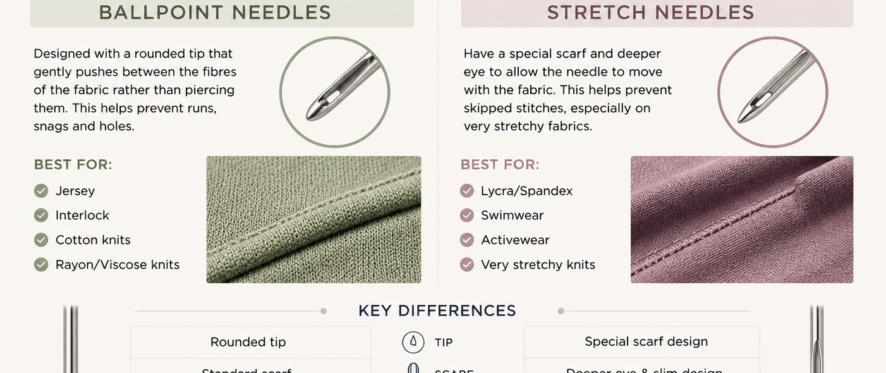
0 items in your cart
Your cart is currently empty.
Start shopping Fast Delivery
Excellet Quailty
Unique designs
Fast Delivery
Excellet Quailty
Unique designs
If you’ve ever sewn a knit fabric only to end up with skipped stitches, tiny holes along the seam, or thread that snaps under tension, the culprit is almost certainly your needle. Two specialist needle types solve these problems: the ballpoint (jersey) needle and the stretch needle. Here’s what you need to know.
Standard sharp or universal needles pierce straight through fabric fibres. That works fine on wovens, but knit fabrics are built from interlocking loops — pierce those loops and you risk breaking them, leaving holes that can slowly unravel or cause runs. The solution is a rounded tip that slides between the loops rather than through them.
The jersey needle — also known simply as a ballpoint needle — uses a medium ball point designed to avoid breakage of knit fibres at stitch creation. It’s suited to knit and stretch knit fabrics generally. Good candidates include cotton jersey, sweatshirt fabric, bouclé, faux fur, and standard knitted fabrics. Ballpoints work well on most knits, especially those with two-way stretch.
The stretch needle has a medium ball point, a smaller eye, and a deep scarf. It also has a specific coating that helps it glide through rubbery fabric strands. These features work together to prevent the skipped stitches that plague highly elastic fabrics. Use it on highly elastic knits, especially where the fibre content includes Lycra®, Spandex, or elastic — the more elastic the material, the more suited the stretch needle is. When in doubt, choose the stretch needle. It’s the go-to for swimwear, fine jersey, silk jersey, and velour.
Both needle types have rounded tips that work their way through fabric fibres rather than piercing through. However, the ballpoint tip is slightly more rounded, so it may work better for looser fabrics. Think of it as a spectrum: ballpoint for standard and moderately stretchy knits, stretch needle when elastane or Lycra is in the mix or when you’re persistently getting skipped stitches. If your machine is skipping stitches no matter what you try, switching from a ballpoint to a stretch needle is often the fix.
On lighter knits, a size 70/10 or 75/11 is a great choice. Size 80/12 works on most knits and is a good standard size to have in your collection. Size 90/14 is best when sewing over bulky seams on thicker knit fabrics.
Always start a new project with a fresh needle — a slightly blunted tip is enough to cause problems on delicate knit loops. And if you’re ever unsure which to reach for, when in doubt, use the stretch needle. It covers more ground and will rarely let you down.